
Mobile Viewing / Viewing on a small screen
Viewing this website on smaller screens will disable the table information. To view this data please view the site on a desktop computer or rotate your device to landscape.

Trees
Maple
(Acer)

Summary
| Order | Family | Genus |
|---|---|---|
| Sapindales
(Sapindales) |
Soapberry Family
(Sapindaceae) |
Maple
(Acer) |
Overview
The Latin 'Acer' means fierce, sharp, irritating, pungent, or bitter.
There are about 128 species of Maple. The most common in the UK are the Sycamore, Field Maple, and Norway Maple. Sycamores are widespread often easily recognisable from their seeds. (which fall to earth like helicopters for a bit of fun for all the family) and their familiar leaf shape (think 'Canadian flag'). Field Maples are widespread through England and Wales but a lot less so in Scotland and Ireland.
Norway Maple has been cultivated to produce many variants of impressive colours and look to their leaves, such as the 'Crimson King', and 'Drummondii'. It is often found as part hedgerows or planted ornamentally and is a smaller tree than field and sycamore.
Sap from Maples is refined into maple syrup. It takes large quantities of sap to produce syrup. Sap can be drawn from all Maples but for the quantities required for syrup Sugar Maple is used commercially.
In my experience, many Maples have 'tar spots' (see gallery). This is caused by the fungus Rhytisma acerium.
Bushcraft
Maple is a useful resource due to its abundance. It has many uses purely from its wood and it can also provide a source of hydration.
Click below for more information of individual species at Plants For A Future website (PFAF.org)
General Info
| Description | Data | Notes |
|---|---|---|
| Season | Deciduous | Flower and seeds between March and May |
| Edible | Yes | Sap from any maple can be used as a drink or refned to make maple syrup |
| Uses | Medium | See below. |
| Burnability | Good | Produces a good flame, and good heat |
| Hardness Rating | 30 | Rough scale of hardness from 0 - 100
(Zero being the softest wood and one hundred being the hardest) |
Gallery and Identification


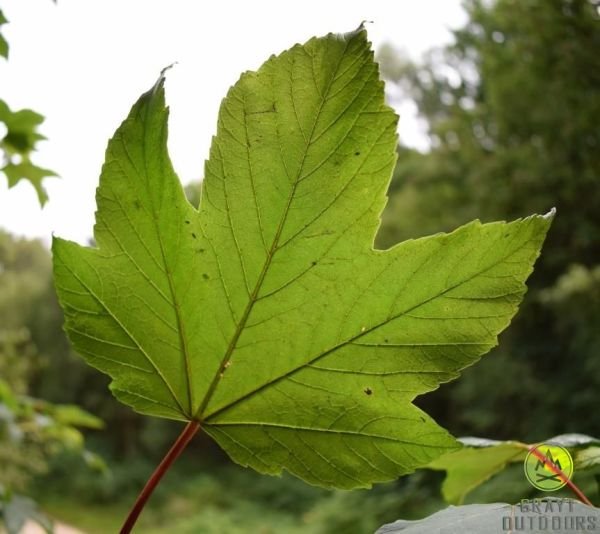


Features common to majority of species:
Size - Species variation - 12m to 35m (Cretan Maple to Sycamore)
Bark - Fissured in most species and a variation of grey in colour.
Leaves - Familiar leaf pattern over most species (see gallery). has 3 to 5 distinct lobes in a variation of greens.
Reproductive Parts - Seeds form in winged pairs and spin when they fall to the ground. The main seed body is green and the 'wings' vary in colour and can be either brown, green and/or red.
Distribution - Common throughout England and Wales but less so in Scotland and at higher altitudes.
Surroundings - Woodlands and urban areas. Norway Maple often planted throughout in parks or small areas of grass.
Distinguishing features - Often seen with black 'tar spots' on their leaves cause by the bacteria Rhytisma acerinum.
Resources
- Firewood
- Charcoal
- Timbre
- Carving wood
Skills
- Carving - Sycamore is a good carving wood fro creation of spoons, bowls, kuksa's etc
Food
- Liquid/hydration - sap from all Maples is drinkable.
- Syrup/Source of carbohydrate - sap can be refined into a syrup. This is probably not all that practical in the field as it requires large quantities but even drank straight from the tree would provide some carbohydrate.