
Mobile Viewing / Viewing on a small screen
Viewing this website on smaller screens will disable the table information. To view this data please view the site on a desktop computer or rotate your device to landscape.

Trees
Yew
(Taxus and Cephalotaxus)

Summary
| Order | Family | Genus |
|---|---|---|
| Pinales
(Pinales) |
The Yew Family
(Taxaceae) |
Yew
(Taxus) |
| Pinales
(Pinales) |
Cephalotaxaceae
(Cephalotaxaceae) The Yew Family (Taxaceae) |
Yew
(Cephalotaxus) |
| Pinales
(Pinales) |
Podocarpaceae
(Podocarpaceae) |
Yew / Plum Yew
(Prumnopitys) Yew (Saxegothaea) |
Overview
As you can see from the table above theThe common name Yew encompasses a variety of genre. The families that the genre are grouped into is also not set in stone and often classes differently depending on opinion. By far the most common in the UK is the Common Yew (Taxus baccata). The majority of the other species are not native to the UK and only found as an ornamental plants.
Yew is the most widely used tree for topiary as it is dense and impenetrable and lives for a long time. Common Yew is most easily identified by its dark flat pines and its female arils (September to November).
A long history of being used for bows and spears and very flexible. The Latin name Taxus appears to be have stemmed from its use as a bow. The word is associated with poison (the same, as in (toxic), which is turn was used on arrows to kill prey. It was also used for flooring, barrel hoops, axels and wheels etc. Today it is used in veneers and ornamental works. There have been 2 chemotherapy drugs developed from Yew Pines.
Bushcraft:
Good firewood. A long history of being used in bow making. Edible fruit.
Click below for more information of individual species at Plants For A Future website (PFAF.org)
General Info
| Description | Data | Notes |
|---|---|---|
| Season | Everygreen | Flowers March to April. Seeds ripen September to November. |
| Edible | Yes | CAUTION: Only the flesh of the fruit is edible in most cases. The rest of the plant is toxic. See below. |
| Uses | Med | Can be used as a source of food. Good fire wood and for making bows. See below. |
| Burnability | Very Good | Prduces a good heat output and burns slowly. |
| Hardness Rating | 48 | Rough scale of hardness from 0 - 100
(Zero being the softest wood and one hundred being the hardest) |
Gallery and Identification




Features common to majority of species:
Size - Species variation - 6m to 25m (Japanese Plum Yew (Cephalotaxus harringtonia) to Common Yew (Taxus baccata))
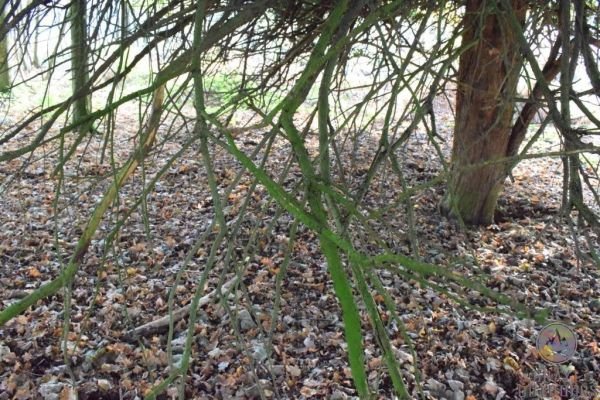
Bark - Brown and smooth in young trees. Has plates over surface on older trees. Can be found with a thin green layer of mould growing on it. Leaves also from in small clusters directly from the trunk.
Leaves - Flattened needles. Individully growing from the main stem. Dark green.
Reproductive Parts - Male and female flowers on seperate trees. Male flowers grow individually and have yellow anthers. Female flowers and green and form into the red fleshy, gelatonus aril that is an easy identifier of a Common Yew tree.
Distribution - Widspread in England and Wales. Less common in Scotland and Ireland.
Surroundings - Quite a resiliant tree so grows in a variety of places. Often found in Churchyards and there are acient Yew woodlands in south England. Common Yew is the most common tree used for topiary due to its long life and dense foliage.
Resources
- Firewood
Skills
- Bow Making
Food
- CAUTION: Most of the plant is toxic. Flesh of fruit is edible